Free Site & SEO Audit - Limited Spots This MonthSites Live in 3–5 Weeks · No Long-Term ContractsCall (425) 243-7632 to Get Started TodayFree Site & SEO Audit - Limited Spots This MonthSites Live in 3–5 Weeks · No Long-Term ContractsCall (425) 243-7632 to Get Started Today
Personal injury · Criminal defense · Family · Immigration
A law firm SEO company and law firm website company, priced against one signed case.
Every agency you have spoken to measures itself in traffic. Your firm is measured in signed matters, and those two numbers have almost nothing to do with each other. So we start from the only figure that matters – what a case is worth to you – and work backwards to what the marketing has to produce before it has paid for itself. Law firm SEO from $250 a week. Small law firm website design at $1,000 one-time. No contract, no account manager, no discovery deck.
The Friday report. Signed matters at the top, rankings further down, because one is an outcome and the other is an input.
$250
Per week, law firm SEO
$1,000
Small law firm website design
1
Firm per market, per practice area
$0
Contracts
First, the part other agencies skip
Your marketing carries your bar number, not ours
Attorney advertising is regulated in ways almost no other industry is, and a marketing agency that has never read a rule of professional conduct will happily publish something that lands on your desk as a grievance. The exposure is yours, so the caution has to be ours.
Every page we publish for a firm is read against the advertising rules of the state it is marketing into, before it goes live.
No outcome promises
We never write anything that reads as a guarantee
Not "we win", not "you will recover", not "guaranteed results". Every jurisdiction restricts language that creates an unjustified expectation, and it is the easiest rule in the book to break in a headline. Our copy is written to persuade without predicting.
Case results
Results carry the disclaimer your state requires
Published verdicts and settlements are among the most persuasive things on a law firm website and among the most regulated. We publish them with the disclaimer language your jurisdiction expects, attached to the result itself rather than buried in a footer nobody reads.
Testimonials
Client reviews handled to your state's rules
Some states restrict testimonials outright, others require specific qualifying language, and several treat a client quote about an outcome differently from a quote about service. We set your review requests up so what comes back is usable, and we do not solicit anything that would not be.
Specialisation
No "specialist" or "expert" claims without certification
Describing an attorney as a specialist where the state requires board certification is one of the more common self-inflicted problems we find on existing firm sites. We audit for it in week one and rewrite anything that overstates.
Jurisdiction
Where each attorney is admitted, stated plainly
Multi-state firms and firms marketing beyond their admission attract complaints. Bar admissions, office locations and the responsible attorney belong on the site in text, not in an image, and every landing page inherits them automatically.
Confidentiality
Intake forms that do not create problems for you
A form that invites case detail before a conflict check creates a headache nobody needs. We build intake that captures enough to qualify, includes the no-attorney-client-relationship language, and hands off cleanly to whoever runs conflicts at your firm.
What the compliance pass actually finds
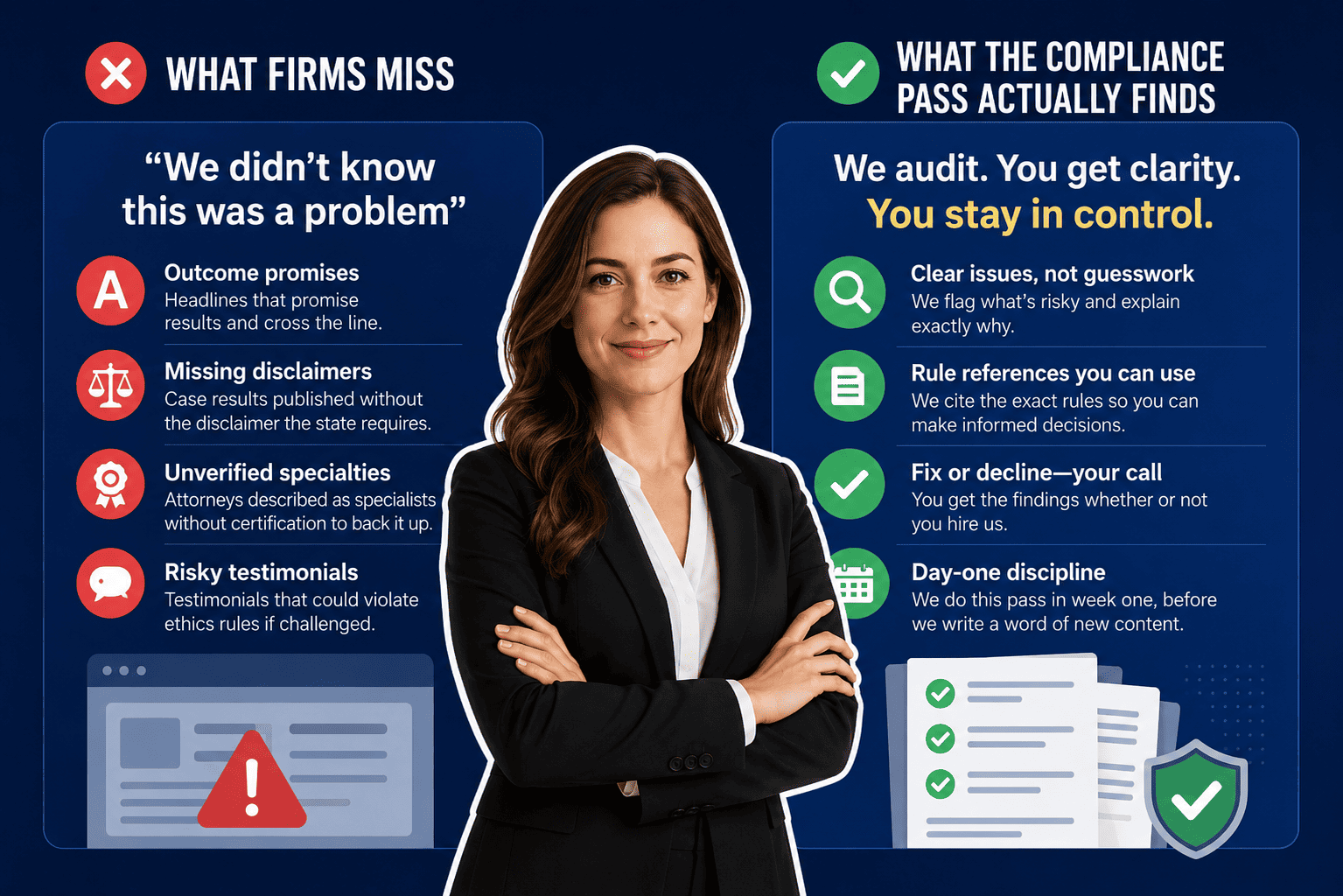
On almost every existing firm site we audit there is at least one of these: a headline that reads as an outcome promise, a case result published without the disclaimer the state requires, an attorney described as a specialist without the certification behind it, or a testimonial that would not survive a complaint.
None of it was put there maliciously. It was written by somebody who had never read a rule of professional conduct and had no reason to think a headline could become a problem.
We do this pass in week one, before we write a word of new content – and you get the findings whether or not you go on to hire us.
A compliance pass over existing copy, flagged line by line against the state's advertising rules.
To be clear about what we are: we are a marketing team, not your ethics counsel. We work to the rules as your state publishes them and we flag anything that looks close to a line, but final sign-off on advertising compliance sits with your firm. Any agency telling you otherwise is taking on liability it cannot carry.
What the market actually searches
The demand, pulled straight out of Keyword Planner
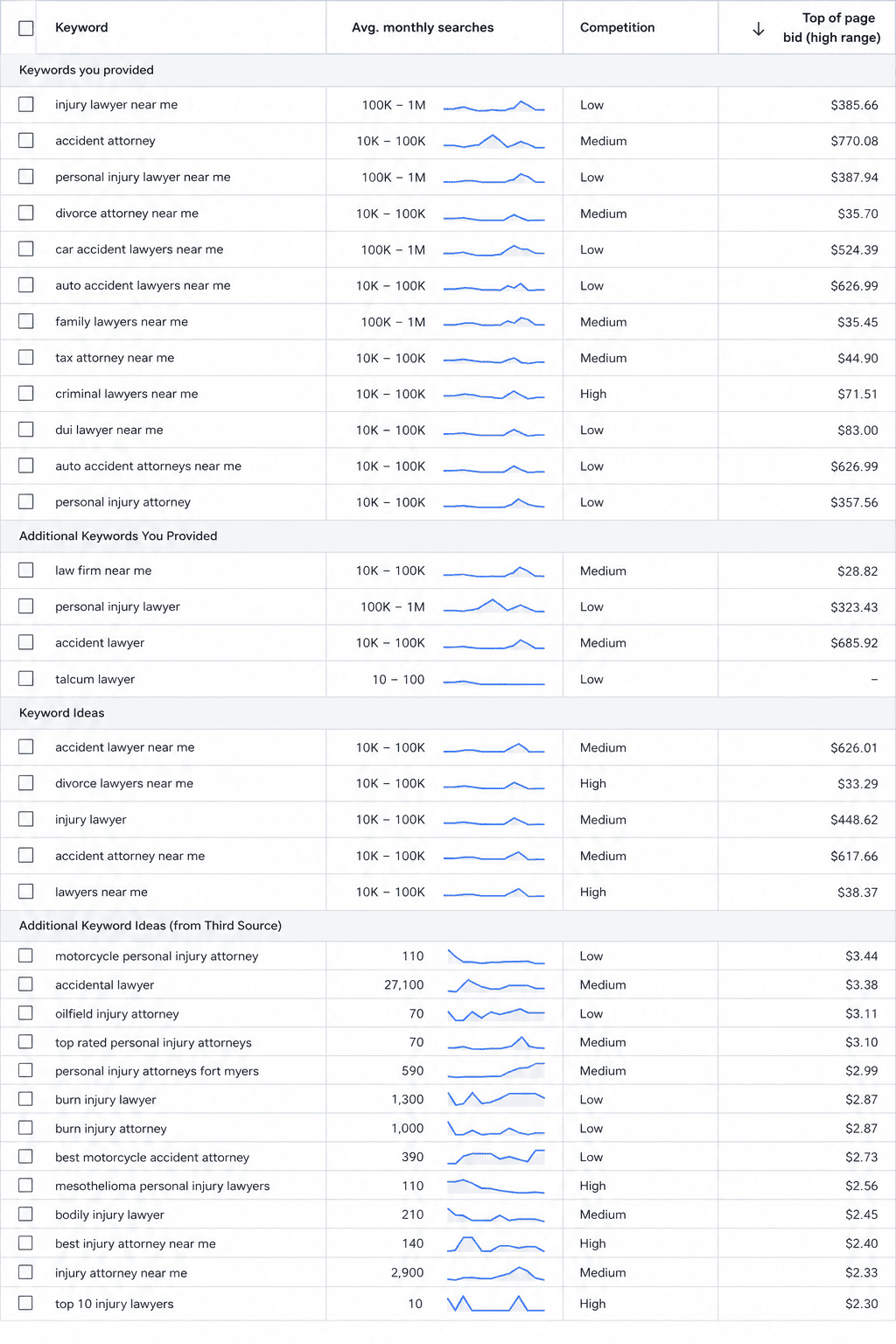
Before a single page gets planned for a firm, we pull the real numbers for its market. Google’s own tool, not a third-party estimate – and the export usually argues against the strategy the firm arrived with.
What you are looking at is an unedited export: every legal query with meaningful volume in a single metro, with the monthly searches, the competition level and the top-of-page bid range Google reports for each one. No rounding, no agency filter over the top, no cherry-picked rows chosen to make a proposal look better than the market is.
Read it once properly and the same thing happens to nearly every firm. The term everybody arrives asking to rank for turns out to be a small slice of the total – and the slice with the most firms stacked on it and the highest cost per click in the category. The volume that actually turns into signed matters is scattered across dozens of narrower queries nobody thought to ask about.
Where the volume sits
The head term is the smallest part of the market
“Personal injury lawyer [city]” is one row. The accident types, injury types and case-stage questions underneath it add up to several times its volume, and each of them is winnable with a page rather than a war.
What the head term costs
The most expensive clicks in local search are in this category
Legal bid ranges are among the highest Google reports for anything. That is useful even if you never run an ad – it is the clearest signal available of what a click in your market is actually worth, and it is what makes the organic position worth building.
The queries with no lawyer in them
A lot of your future clients have not thought of hiring anyone yet
Whether an injury is worth anything, whether to accept the first offer, how long there is to file. High intent, no competition from firms, and almost never covered on a firm’s site because it does not look like a money term in a spreadsheet.
Yours, at no cost
Want this pulled for your own market?
Tell us the city you practise in and the case types you want more of. We will run the same export for your market and send it across as a spreadsheet you can keep, forward, or hand to whoever you hire next.
Every legal query with real volume in your metro, not a sample
Monthly search volume, competition and top-of-page bid range per term
Grouped by case type, with the head terms separated from the long tail
A short note on which groups your site can realistically compete for now
No call required, nothing to sit through, no list to unsubscribe from afterwards. It is about an hour of our time and you keep it whether or not you ever speak to us again.
A live Keyword Planner export for one metro – the same view we work from when deciding which pages a firm gets built first.
Why firms leave their last agency
The same six complaints, about every law firm SEO agency
We have spent a long time listening to attorneys describe the engagement they just ended. The stories are close to identical. Here they are as a ledger, with what we do differently in the right-hand column.
What you were sold
What actually arrived
How we handle it
SoldFirst-page rankings inside six months, with a case study to prove it.
ArrivedSix months and five figures gone, still invisible for the terms that would have paid for it.
UsWe put timing in writing before you sign: four to eight weeks for first movement, three to six months for real case volume, six to twelve for the competitive practice area terms. If your market is worse than that, you hear it before you pay.
SoldMonthly reporting so you always know where you stand.
ArrivedImpressions up, clicks up, traffic up, consultations flat. Nothing on the report was a case.
UsThe first line of every report is signed matters attributed to the work, then consultations, then calls. Rankings appear further down because they are an input, not an outcome.
SoldFull transparency on where your leads come from.
ArrivedNobody could connect a single retained client to a single marketing dollar.
UsCall tracking and form attribution go live in week one, before any content is written. If we cannot trace it, we do not claim it – and if the leak turns out to be in your intake rather than our marketing, we say that.
SoldA dedicated team and a named strategist.
ArrivedMissed deadlines, unanswered email, and months where it turned out almost nothing had been done.
UsYou get the person doing the work, directly, no account manager in between. The Friday report says what shipped that week. A quiet week gets reported as a quiet week.
SoldAuthoritative legal content, published monthly.
ArrivedGeneric six-hundred-word posts no prospect would finish and no search engine had reason to rank.
UsFewer pages, written properly. Eight practice area pages that are genuinely the best resource on that case type in your market beat a year of filler, and legal is a category where Google is unusually strict about who it trusts.
SoldWe handle everything so you can practise law.
ArrivedThe agency held the domain, the site and the Google profile. Leaving became a negotiation.
UsDomain, site, content, analytics, Google Business Profile and ad account are registered to the firm on day one, with every login yours. Leaving costs you the notice period and nothing else.
The part rankings do not fix
Your prospect contacts three firms in one sitting and retains whoever engages first
This is the single biggest difference between legal marketing and marketing for almost anything else. Nobody shortlists lawyers over a fortnight. They are on a shoulder or in a car park with a phone, they contact two or three firms in ten minutes, and the matter is effectively decided before any of the three have opened a file.
The firm ranked thirdAnswered live at 6:13pm
Retained
The firm ranked firstForm auto-reply, called back next morning
Too late – already signed elsewhere
The firm ranked secondVoicemail, no callback logged
Never contacted the prospect
What your prospect is actually looking at. Three firms, a rating, a distance and a call button. That is the whole decision surface, and it is decided in about nine minutes.
Which is why we build tracking before we build content. If your firm ranks second and signs nothing, more rankings will not help you – and we would be taking your money to make a problem more visible rather than smaller. In the audit we call your own intake line at the hours your case types actually get searched, and we tell you what happened. Several firms have ended that conversation by fixing the phone instead of hiring us, which is a perfectly good outcome.
Before you compare quotes
What legal marketing SEO has to produce before it has paid for itself
Marketing quotes get compared against each other, which is the wrong comparison. The useful one is against your fee on a signed matter. At $250 a week – roughly $13,000 a year – here is what the programme has to return.
Work it on your own number first
Take your fee on one signed matter in the practice area you most want to grow. Not your average across everything – the one you would happily take three more of this year.
Divide the annual cost of the programme by it. That figure is the entire decision, and it is the one we would want to see before signing anything ourselves.
Here is the arithmetic on a typical felony defense retainer, and the table below runs the same sum across every practice area we work in.
Additional signed cases required per year to cover law firm SEO at $13,000 annually, by practice area.
Practice area
Illustrative fee per signed matter
Extra cases to break even
What that tells you
Catastrophic injury / truck
$100,000+
Under 1
One matter in twelve months covers a decade of the retainer.
Personal injury, standard
$15,000
1
Break-even lands in the first quarter in most markets.
Criminal defense, felony
$8,000
2
Two extra retainers across a year. Low bar to clear.
Divorce, contested
$6,000
3
Comfortable, provided intake follows up more than once.
Employment claim
$5,000
3
Works where claim-type pages target filing deadlines.
Immigration, per matter
$3,500
4
Achievable, but volume has to be real. We check first.
Estate planning, flat fee
$1,500
9
Tighter. Worth doing only alongside higher-fee work.
Traffic / minor misdemeanour
$750
18
Honest answer: this alone rarely justifies a retainer.
Fee figures above are illustrative brackets for working the arithmetic, not claims about your market – actual fees vary enormously by jurisdiction, case complexity and fee agreement. We build this same table with your real numbers during the audit, and the bottom two rows are the reason we occasionally tell a firm not to hire us.
The pages that actually sign matters
One page per case type, because these are eight different people
The most common structural fault we find on a law firm website is a single Practice Areas page listing nine services in bullet points, ranking for none of them. A person googling at 11pm after an arrest and a person quietly researching divorce for three weeks need almost nothing in common from you.
01
Car accidents
Highest volume
How they arriveSame day or the next morning, frequently from the roadside, usually on a phone with poor signal.
What the page must carryWhat to do in the next 24 hours, how the fee works, tap-to-call before any scroll.
02
Truck & commercial vehicle
Highest value
How they arriveA family member researching days later, comparing firms carefully, often after a referral.
What the page must carryWhy trucking cases differ, evidence preservation timelines, results with proper disclaimers.
03
Criminal defense
Fastest decision
How they arrivePanicked, at night, sometimes from a relative's phone rather than the defendant's.
What the page must carryThe specific charge, the county and its court, and a number a human answers now.
04
Divorce & custody
Longest consideration
How they arriveReading quietly for weeks, often without telling the other person in the house.
What the page must carryThe process month by month, realistic cost ranges, and a tone that does not humiliate them.
05
Wrongful death
Highest sensitivity
How they arriveGrieving, frequently referred, comparing two or three firms without much appetite for any of it.
What the page must carryRestraint above all. Who may file, what the timeline looks like, no marketing language.
06
Immigration
Highest research volume
How they arriveAfter months of reading, often in a second language, frequently on a shared device.
What the page must carryStatus and visa specific pages, properly written second-language versions, fees stated plainly.
07
Employment claims
Deadline driven
How they arriveRecently terminated, angry, and usually much closer to a filing deadline than they realise.
What the page must carryClaim-type pages, the deadline stated early, contingency terms explained without hedging.
08
Estate & probate
Referral led
How they arriveAn executor working out their duties, no urgency, choosing on clarity rather than persuasion.
What the page must carryThe process walked through step by step, and flat fees where you publish them.
Why the bullet list fails
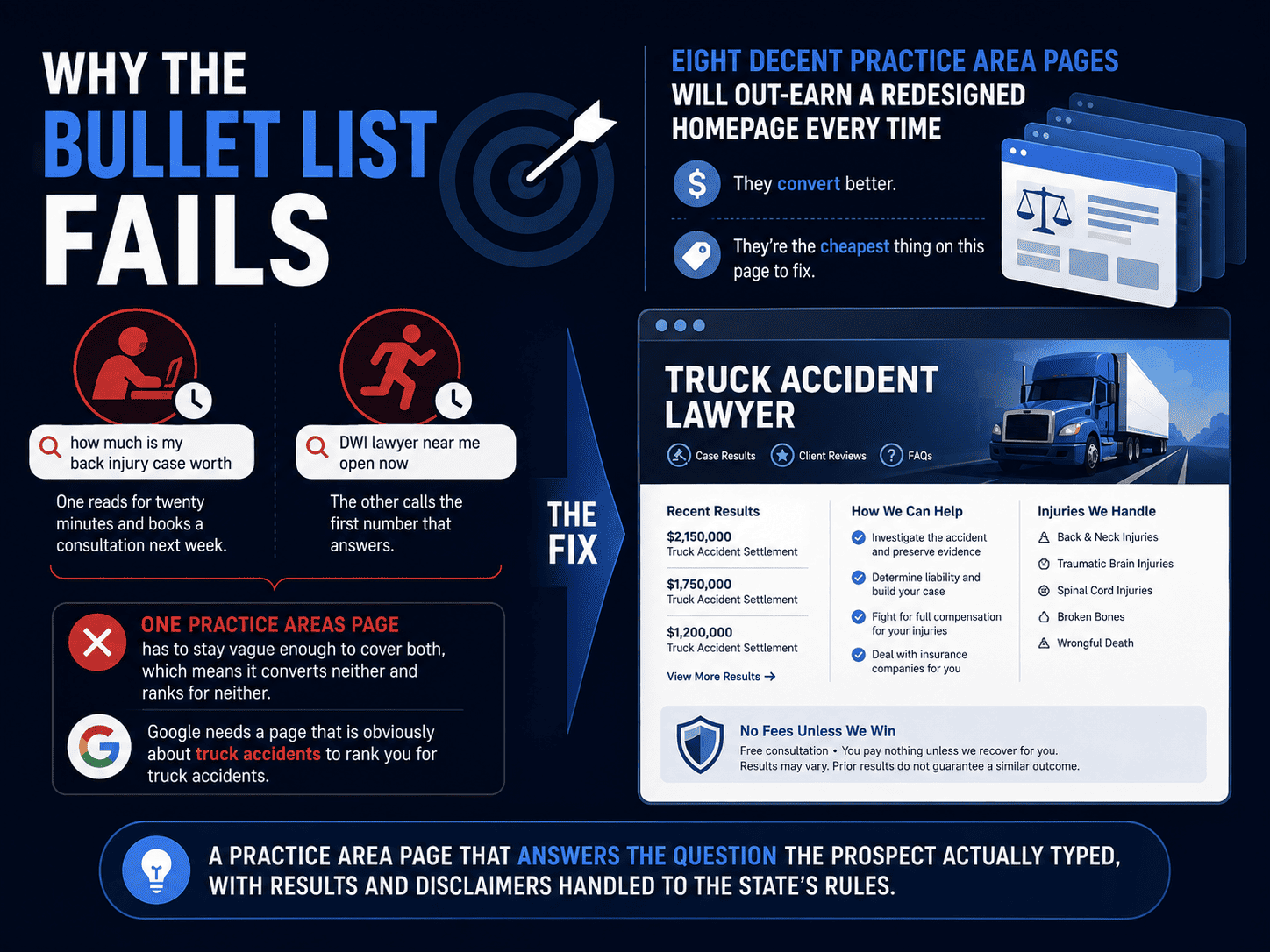
Someone searching "how much is my back injury case worth" and someone searching "DWI lawyer near me open now" have nothing in common except that you can help them both. One reads for twenty minutes and books a consultation next week. The other calls the first number that answers.
A single Practice Areas page has to stay vague enough to cover both, which means it converts neither and ranks for neither. Google needs a page that is obviously about truck accidents to rank you for truck accidents.
Eight decent practice area pages will out-earn a redesigned homepage every time, and they are the cheapest thing on this page to fix, because the material already exists in your head. You explain most of it at consultations every week.
A practice area page that answers the question the prospect actually typed, with results and disclaimers handled to the state's rules.
How ranking is decided
How Google picks which law firm to show, and where firms lose it
One results page, two separate contests. The map pack is settled by Google’s local ranking system, which turns on three inputs the company names publicly. The listings underneath are settled by the ordinary web ranking systems, held to a heavier bar because legal guidance sits in the group Google treats as consequential to get wrong. Most firms are losing both – for reasons that barely overlap.
Local input 01
Relevance
How well the listing matches what was typed
What is being measuredA profile categorised as “Law Firm” with a website carrying a single Practice Areas page is a weak match for truck accident attorney, no matter how many trucking cases the firm has actually tried. Google is matching text to text, and it has very little text to work with.
Where firms lose itA default primary category, practice areas missing from the services list, and eight case types compressed into one page. This is the input a firm controls most directly and neglects most often – and it is usually a week of work rather than a quarter.
Local input 02
Distance
How far the searcher is from the office
What is being measuredThe gap between the searcher and your address, weighed against the same gap for every competing firm. Where no location appears in the query, Google infers one from the device, which is why the same search returns different firms from two sides of a city.
Where firms lose itNothing here changes without a lease, so it gets dismissed – wrongly. Distance defines the boundary of the market a firm can realistically win, and it is the whole argument for building county and suburb pages before spending anything chasing a state-wide term.
Local input 03
Prominence
How well known the firm is, drawn from the whole web
What is being measuredReview count and rating, consistent citations, links, bar and directory listings, and mentions in coverage of the matters you handle. Offline reputation feeds this too – a firm that is genuinely established in a market usually leaves a trail Google can read.
Where firms lose itReview volume, nearly every time. Legal clients review outcomes rather than service, so firms quietly stop asking after a bad month. Prominence is the slowest of the three to build and the hardest for a competitor to copy, which is precisely why it is worth the discomfort.
A pattern worth naming
The category ceiling
Of the three inputs above, only relevance behaves like a ceiling rather than a dial. The primary category on a Google Business Profile sets a hard upper bound on which searches the firm is eligible to appear for in the map pack at all. Underneath that bound everything else works normally. Above it, nothing works – not reviews, not links, not pages, not budget.
Categorised as “Law Firm”Eligible for the generic queries. Lawyer near me. Law firm in [city]. Attorney [city]. High volume, low intent, and the queries every firm in the metro is stacked into.
Categorised as “Personal Injury Attorney”Eligible for all of the above plus the accident-type and injury-type queries, which is where the matters worth signing actually come from.
The distance between those two ceilings is worth more per year than most retainers cost, and moving between them is a fifteen-minute change made from a phone. It is the only fault we know of in local search where a firm can execute everything else correctly and register no movement for six straight months, because the work is being done above a line the profile will not let it cross.
It is also why line 02 of our work log is the profile rather than content. You cannot content your way through a category ceiling. We check it before we quote, and if it is the only thing wrong we say so and tell you to go fix it yourself rather than sell you a retainer.
Input
Who controls it
Time to move
Can a rival copy it
What it does when it is wrong
Relevance
The firm, entirely
Days
Yes, in an afternoon
Imposes a ceiling. Everything above it fails silently.
Distance
Nobody, short of a second lease
Never
Not applicable
Draws the boundary of the market. Cannot be wrong, only misjudged.
Prominence
The firm, slowly
6–18 months
No, and this is the point
Acts as drag rather than a ceiling. Everything still works, just less.
Read the table left to right and the sequencing argument makes itself: do the thing that is free, fast and entirely yours before you spend a year on the thing that is slow, expensive and cumulative. Almost every legal SEO proposal we have been shown by a firm getting a second opinion does it in the opposite order, because prominence is what an agency can bill monthly and relevance is a job that finishes.
The listing below the map is judged on something else entirely
Organic results are not scored on category and proximity. They are scored on whether the page is the best answer available, and legal pages carry an extra weight that a recipe or a product review does not. Google’s own guidance groups law alongside medicine and finance as subject matter where a wrong answer costs the reader something real, and the standard applied to that group is visibly higher. In practice it comes down to four things a firm can either demonstrate or cannot.
First
Experience
Did the person writing this ever do the thing? A page on wrongful death filings in your county should read like it was written by somebody who has filed one – deadlines, the clerk, what the family is actually asked for. Second-hand summaries of a statute read exactly like second-hand summaries of a statute.
Second
Expertise
Named attorneys, bar admissions stated in text rather than implied by a badge graphic, and a real biography attached to the byline. A legal page published under “Admin”, or under no author at all, is asking to be taken on faith by a system built specifically not to do that.
Third
Authoritativeness
Whether the rest of the web treats the firm as a source. Citation in local reporting on a case, bar association and court listings, links from organisations that do not sell links. Slow, cumulative, and the reason a two-year-old firm cannot buy its way past a twenty-year-old one in a quarter.
Fourth
Trust
The one the other three exist to support. A physical address, a number that gets answered, fee structure stated rather than hidden behind a form, disclaimers attached to every result, and no outcome language anywhere on the site – which is also what your state bar requires, so the two obligations happen to point the same way.
A necessary caveat, since plenty of agencies sell this as a setting: none of the four is a dial inside the algorithm. They come from the guidelines Google issues to the human raters who score search results, and those scores test whether the ranking systems are working rather than rank any individual site. They still matter, because the systems get tuned until their output looks like what the raters reward. Anyone quoting you a price to “raise your E-E-A-T score” is selling a number that does not exist.
Score your own firm in about four minutes
Twelve checks, in the order we run them before quoting. Nothing here needs a tool, a login or an audit – open your Google Business Profile and your own website in two tabs and tick what is true. The score is not a ranking prediction. It tells you which of the three inputs is the one actually holding you.
Relevance · five checks
Trust and the organic listing · four checks
Prominence · three checks
0 / 12
Nothing ticked yet
Work down the list with both tabs open. Most firms find the first five faster than they expect, and the first five are the ones that matter most.
One rule that overrides the score: if check one is unticked, the other eleven are being run above a category ceiling and the total means very little until it is fixed.
What we have never once seen move a legal ranking
Publishing for the sake of publishing. Four short posts a month on general legal topics, none of which map to a case type the firm wants more of.
Keyword density. Repeating “Houston personal injury lawyer” eleven times in nine hundred words. This stopped working around 2012 and now reads as a warning sign.
Bulk citation submissions. Two hundred directory listings on sites no client has visited, sold by volume because volume is easy to invoice.
Bought links. Fast for a quarter, then a manual action or a quiet collapse that takes eighteen months to recover from, on your domain rather than the agency’s.
An exact-match domain. houstoninjuryattorney.com has not been an advantage for years, and it costs you the firm name as a brand entity.
A redesign on its own. A better-looking site with the same eight-in-one practice page ranks exactly where the old one did, and sometimes worse if the URLs moved.
There is nothing proprietary above – the three local inputs are documented by Google and the rater guidelines run to well over a hundred pages in public. It is the sequence that firms get wrong: category and profile first because relevance is cheap to fix, then the case-type and county pages that make the site an obvious match, then reviews and links over the following year. We run that same order for every local business we work with through our SEO work and the sites we build, whether the client is a firm in Houston or a practice in Nashua. What changes for law firms is the trust bar, and it is not a small change.
One firm per market
We will not take on the firm across the street.
Plenty of legal SEO companies run four personal injury firms in the same metro and describe it as scale. It is not scale. It is a conflict, and it means your retainer is funding research, content patterns and link relationships that get reused on the firm competing with you for the same matters.
We take one firm per practice area per market, and it goes in the agreement rather than being promised on a sales call. If your market is already spoken for we will tell you on the first call instead of taking the meeting.
Ask every agency on your shortlist this question in writing. The answer separates them faster than any portfolio.
Houston · personal injuryOpen
Austin · criminal defenseOpen
Dallas · family lawOpen
San Diego · immigrationOpen
Nashua · estate & probateOpen
Your market · your practice areaAsk us
What is included
Law firm SEO marketing: the monthly work log, itemised
Law firm SEO, law firm website design and ads from the same team, priced separately so you can take one, two or all three. Every line below appears on the Friday report as done, in progress, or not this week.
01
Call tracking and form attribution
Built first, before a word of content. Every consultation traces back to the search, the page and the campaign that produced it. Without this the rest is guesswork dressed as reporting.
Week one
02
Google Business Profile
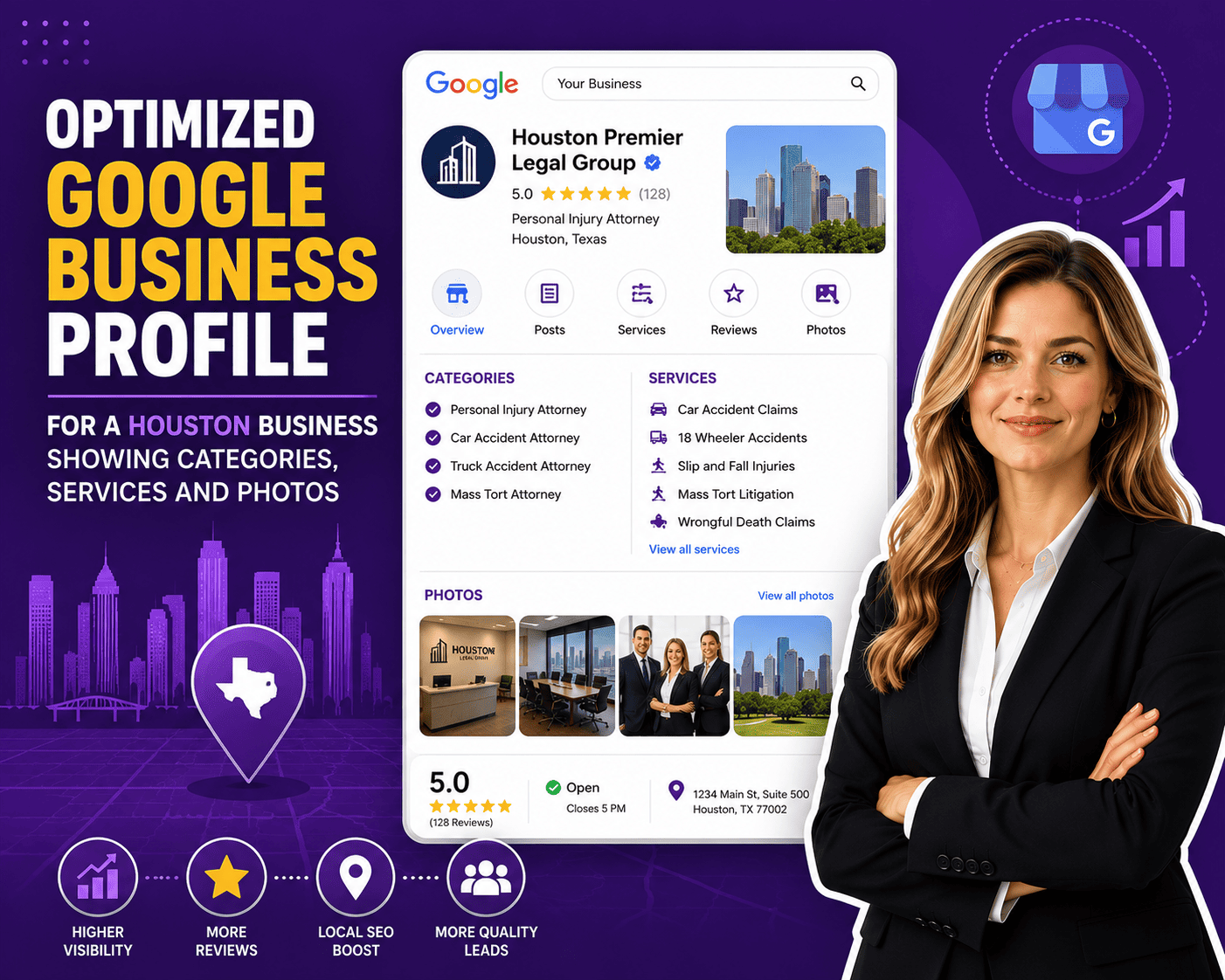
The largest single lever on whether you appear in the map pack, which is where the highest-intent legal searches are decided. Correct primary category, every practice area listed as a service, real photographs of the office, Q&A seeded before somebody else answers for you.
Law firm SEO
03
Practice area pages
One real page per case type you want more of, written to your jurisdiction, with results and disclaimers handled to your state's rules. This is the work that moves matters rather than metrics.
Law firm SEO
04
County and suburb coverage
Legal hiring is local to a degree few industries match, and courthouse geography matters as much as postcode. We build the pages for the counties you actually appear in rather than the whole state.
Law firm SEO
05
Law firm website design
Around five pages, custom, copy written for you. Case results, fee structure, admissions, a consultation form that does not create conflict problems, and a number that is tappable before any scroll. $1,000 one-time.
Website
06
Review generation and response
Legal reviews skew harsher than most industries because clients review outcomes rather than service. We set the ask at the right point in the matter, within your state's testimonial rules, and get you replying properly to the difficult ones.
Law firm SEO
07
Technical SEO and page speed
Attorney and legal service schema, clean internal linking, indexation, and pages that load in about a second on cell data. Your prospect is comparing three firms from somewhere stressful.
Website
08
Google Ads, where the fee justifies it
Legal clicks are among the most expensive anywhere, which punishes loose targeting immediately. We run ads for the case types where one signed matter pays for the quarter, and we will tell you when your budget is below the level at which paid search can work in your market.
Ads
09
Friday report
One page. Signed matters first, then consultations, then calls, then rankings. What shipped, what is next, and what we would do differently. A slow week is reported as a slow week.
All plans
Where the map pack decides it
Legal hiring is local to a degree few industries match, and the three results above the organic listings take a disproportionate share of the highest-intent searches in your market. Fourth place is a scroll away and might as well not exist.
Which three appear comes down to category, proximity and reviews, in roughly that order – and a wrong primary category on a Google Business Profile is the single most common fault we find, quietly capping everything else a firm is paying for.
It is also the fastest thing on the list to fix, which is why it sits at line 02 rather than somewhere in month three.
Local pack position before and after the profile work, across the counties a firm actually draws matters from.
The build side
Law firm website designers who write the copy, not just the layout
Most law firm website designers hand back a template with grey placeholder text where the practice area pages should be, and the firm never fills them in. We write the pages as part of the build – which is also the only way the site arrives ready to rank.
One attorney, one metro
Small law firm website design, built for the firm you actually are
A solo or three-attorney firm does not need the thing a hundred-lawyer firm needs, and paying for it is how firms end up with a twenty-thousand-dollar site nobody updates. Small law firm website design is a narrower job on purpose: five to eight pages, one practice area done properly, the counties you actually take matters from, and an intake form that hands off cleanly to whoever runs conflicts.
Ours is $1,000 one-time, copywriting included, live in three to five weeks. The firm owns the domain, the hosting login and the content from day one, so nothing here holds you hostage if you decide to go elsewhere later.
Built in, not bolted on
Attorney website SEO handled during the build rather than after it
Attorney website SEO retrofitted onto a finished site is always more expensive than doing it during the build, because the fixes are structural: URL patterns, the page-per-case-type split, heading structure, internal links between practice areas and county pages, schema for the firm and each attorney, page speed.
None of that is visible in a design mockup, which is why a designer with no SEO obligation has no reason to get it right. We do both jobs, so there is nobody to hand the problem to.
Outside the US
SEO for solicitors and firms outside the United States
We work with firms in England, Wales, Scotland and Ireland as well as the US. SEO for solicitors runs on the same three local ranking inputs, but the compliance layer is different – SRA transparency rules on price and complaints publishing, rather than state bar advertising rules – and the search language differs enough to matter. Nobody in Manchester types “attorney”.
If your firm is outside the US, say so when you get in touch and we will price it against your jurisdiction rather than translating an American plan into pounds.
Find your firm
A solo practice and a six-office firm are not the same job at different scales
They are different problems, and the plan that suits one actively wastes money for the other.
If this is you
Solo practitioner
You cannot outspend the firms running television, and attempting to is how solos lose two years. Solo law firm SEO works on concentration: one primary practice area, one metro, pages deeper than anyone else has bothered to write, and a solo law firm website design built to convert a higher share of a smaller pool rather than to look like a hundred-attorney firm.
Needs: narrow scope, map pack first, an honest budget conversation
If this is you
Small firm, two to five attorneys
More capacity than a solo, a fraction of the budget of the advertisers above you. Small law firm SEO is mostly a prioritisation problem, and the answer is usually the case types the large advertisers treat as an afterthought, plus the suburbs and counties their city-centre pages quietly ignore.
Needs: case-type selection, county coverage, conversion work before volume
If this is you
Personal injury practice
The most expensive click category in the country, which punishes broad targeting instantly. The organic side is far less contested than the ad auction suggests: "digital marketing for personal injury lawyers" returns a competition index of four. We would rather own twenty accident-type and suburb pages than bid against a billboard firm on head terms, and case value should set the budget, not the other way round.
Needs: accident-type pages, map pack dominance, speed to lead above all
If this is you
Criminal defense practice
A mobile and availability problem before it is a content problem. Charge-specific and county-specific pages compete with almost nobody and convert better, because they demonstrate you have stood in that courthouse. Then somebody has to answer at 11pm, or the ranking is decoration.
Needs: charge and county pages, after-hours answering, tap-to-call everywhere
If this is you
Family, immigration or employment
Three long-research practice areas where content and tone do the persuading. Family law prospects read for weeks before contacting anyone and choose on reassurance. Immigration carries heavy informational volume that never retains, plus real second-language demand that does. Employment is deadline-driven, which makes claim-type pages unusually effective.
Needs: process content, honest cost ranges, tone that does not perform aggression
If this is you
Multi-office firm
The most common structural fault we find. Three offices, one website, near-identical city pages, and Google picking whichever it prefers for every search while the other two collect nothing. It is an architecture fix and it usually moves more than any volume of new content.
Needs: location architecture corrected before anything else is written
If this is you
Newly opened firm
No reviews, no history, no authority, and you cannot out-rank a firm with three hundred reviews in month one. The sequence matters more than the effort: profile built properly, citations consistent, the first twenty reviews collected quickly, ads carrying the load while organic catches up. Anyone promising page one in ninety days for a brand new firm is guessing.
Needs: ads first, reviews urgently, patience on organic
Fee schedule
Published, itemised, and not bundled to hide anything
Law firm SEO cost is one of the highest-intent questions in this category and almost nobody answers it. Most agencies quote a single number covering SEO, website and ads so you cannot see what you are paying for. Here it is on separate lines, the way you would present your own fees.
Service
Fee
What it covers
Law firm SEOMonth to month, cancel any week
$250per week
Profile management, practice area pages, county coverage, citations and local links, review generation, technical work, and the Friday report. Growth tier $500/week, aggressive $850/week for genuinely brutal markets, which most large personal injury metros are.
Law firm website designOne-time, roughly five pages
$1,000one-time
Custom design and build, copywriting included, case results and disclaimers set up to your state's rules, admissions and responsible-attorney details, intake form, and domain setup. Registered to the firm from day one.
Google Ads managementMedia spend paid to Google directly
$250per week
Account build, dedicated landing pages, negative keyword discipline and ongoing management. Your media budget goes to Google, not to us, and we will tell you if it sits below the level at which paid search can work in your practice area.
Honest caveat: if you are a national personal injury firm running television across twelve markets, this is not built for you and an enterprise agency will serve you better. We would rather say that on the call than take the retainer and learn on your firm. Full breakdown on the pricing page. Texas firms: see SEO in Houston or Houston website design.
Realistic expectations, in writing
How long law firm SEO takes, phase by phase
Any legal SEO company promising page one inside thirty days is either guessing or buying links that will cost you later. This is the honest sequence, and it goes in the agreement.
Weeks 1–2
Tracking and foundation
Call tracking and attribution live. Profile rebuilt, categories corrected, compliance audit on existing copy, technical faults cleared.
Weeks 3–6
Practice area pages
Your highest-fee case types written properly. Citations cleaned. Review system collecting. Map pack impressions usually move before rankings do.
Months 2–4
The phone changes
Less contested case-type and county terms come into range. Most firms notice the calls before they notice the report.
Months 4–8
Competitive terms
The head terms in your practice area come into play, carried by the reviews and pages accumulated over the earlier phases.
Ongoing
Maintenance
New case types, new reviews, competitors responding, Google updating. Law firm SEO is not a project that finishes.
One caveat worth stating plainly: if your firm has eleven reviews and the three firms around you have three hundred each, SEO alone will not close that gap this year. Reviews come first, and we will say so before you sign anything.
Due diligence
Six questions to put to every law firm SEO company on your shortlist
Search for the best law firm SEO companies and you get listicles written by the agencies on them. These are more useful, and they work on us – ask them on our call and hold us to the answers in writing.
Question 01
Can you show me the keyword research behind this plan?
A serious agency has it open in a tab already. Ask for the actual search volumes and competition figures for your practice areas in your market, not a case study from a firm three states away. It takes ten minutes to produce if the research exists.
Red flag: a plan written before anyone looked at your market
Question 02
Will you take on my direct competitor?
Ask it plainly and get it in writing. Several legal SEO companies run multiple firms in one metro and call it scale. It is a conflict, and it means you are funding the research that helps the firm across the street.
Red flag: "we keep the teams separate"
Question 03
Who owns the domain, the site and the Google profile?
This matters more than the contract length, because it turns leaving into a negotiation rather than a notice period. The answer should be the firm, on the firm's accounts, from day one, with every login in your possession.
Red flag: vagueness about where the logins live
Question 04
How do you handle my state's advertising rules?
If the answer is a blank look, walk. Disclaimers on results, testimonial restrictions, specialisation claims and outcome language are all jurisdiction-specific, and every one of them lands on your bar number rather than theirs.
Red flag: "our legal team reviews everything" with no specifics
Question 05
What happens in month four?
Every agency has a strong first month, because month one is the obvious fixes and they feel dramatic. Ask what specifically happens once the profile is corrected and the practice area pages are live. Strategy is what happens after the easy wins run out.
Red flag: the answer is "ongoing optimisation"
Question 06
How will you attribute a signed matter to this work?
Not traffic, not leads. A retained client. If they cannot describe the tracking that connects a search to a signature, they are selling you visibility and letting you assume the rest follows.
Red flag: reporting that stops at form fills
Our answers, for the record: yes to the research, no to your competitor, the firm owns everything, we work to your state's published rules with final sign-off staying with you, month four is county pages and link acquisition, and attribution runs to signed matters because we build the tracking in week one.
Results
What clients actually say
Every review below is published on Trustpilot or our Google Business Profile, in the client's own words. See the full breakdown on our Projects page.
Legal
They fixed things on our profile I didn't know were broken - the category was wrong the whole time we'd been open. Rankings moved within a few weeks. What I appreciate most is that I can text and get an actual answer the same day, which was never true with the last company we used.
FrankShore Law
Automotive
I liked working with these guys, super fast work, and honestly impressed with how much they do for so less.
Dennis WhiteDenny's Auto
Industrial cleaning
We do industrial cleaning, and we have started to get 10-20 leads a month extra from our website. And in our industry the search demand is really low and most of it goes to companies running PPC, so even one or two extra clients a month means $40-50K per month for at least a year.
Natalie CramerRose Cleaning
Website design
Very clear communication from the start. Loved my sales rep Frank. Guy's a straight shooter. Lovely website they designed for us.
The Cute BakeryTrustpilot · Dec 2024
Working with us
Cool guys, very upfront from the start. All around stand up guys.
Rohit MandalTrustpilot · Dec 2024
Website design
I was just randomly giving calls to web design agencies to get quotes. Didn't think one month later I'd have a live website that I love. Quite surprised how well it's been put together.
John ReillyTrustpilot · Dec 2024
Branding
I like the logo they designed. Also very responsive guys, loved working with them from the start. Def happy with the results.
Debra SmithTrustpilot · Dec 2024
Working with us
They really have a sense of experience of end customer. Service is very consistent and my account manager Frank was very attentive to my requirements which made it very easy to work with them. Overall a smooth experience.
Lucas MadonTrustpilot · Dec 2024
SEO
Their SEO services are really good. We got a landing page from them but the best part was the ongoing SEO pack. We are consistently seeing traffic thanks to Waystar.
Keith EdwardTrustpilot · Dec 2024
Ongoing support
We love working with these guys. We got the premium service package and it's the easiest to get stuff on and off the page so fast.
Frank MorganTrustpilot · Nov 2024
SEO
I had called around so many agencies and they were so out of my budget that I had almost given up on searching for marketing company. But these guys did SEO and optimised my page and we are starting to get results. Also Ashraf is really easy to work with and very professional. Definitely recommended!
AkashiTrustpilot · Nov 2024Verified
Working with us
I am writing this again cuz Frank asked. He saw our website from start to finish and kept us in loop. It was a easy experience to get a website from you guys. Thanks.
JenniferTrustpilot · Nov 2024Verified
Results
You guys did a fantastic job on my page. I am getting calls from people who are finding us online. Def recommended for business owners.
Emma JamesTrustpilot · Nov 2024Verified
Branding
Gotta thanks Frank for the advice on the color scheme. I never would've thought of the combo you suggested but now it looks perfect across the site. Thanks guys.
Adam RossTrustpilot · Sep 2024Verified
Mobile
They made our website smartphone friendly, it was a seamless experience working with them ❤️
ZikraTrustpilot · Sep 2024
Small business
I was in search of a website building site for my small business for soo long, finally found Waystar Studio and I cant be more happy. Their website designs are gorgeous and pretty functional, reasonable price…
Shabana PerveenGoogle Business Profile
Website design
Waystar Studio did a great job on our website! The team was super helpful and easy to work with. Definitely recommend.
Sandip MaitiGoogle Business Profile
Website design
Truly creative and well-structured website! Every section flows perfectly, and the color scheme gives it a very professional look.
Sunny MishraGoogle Business Profile
Working with us
Good! I especially loved how they paid attention to small details, making the whole experience feel personalized. A five star.
DianGoogle Business Profile
SEO
They did great SEO for my page. Still getting traffic without active management to this day.
JenniferGoogle Business Profile
Small business
Best website agency for small businesses. Loved working with you.
AshleyGoogle Business Profile
Small business
Really smooth experience, best for small business.
Michael KetnerGoogle Business Profile
Results
Fast, reliable, and easy to work with. Very happy with the results.
Kishan BathamGoogle Business Profile
Website design
Great service, professional team, and excellent website design. Highly recommended.
DaniellaGoogle Business Profile
Ongoing support
Great guys, really easy to work with. I was just searching on Google for a website company, came across them by accident. Its been a month and for the first time i can just comfortably leave all the website work to them.
X GraphicGoogle Business Profile
Legal
They fixed things on our profile I didn't know were broken - the category was wrong the whole time we'd been open. Rankings moved within a few weeks. What I appreciate most is that I can text and get an actual answer the same day, which was never true with the last company we used.
FrankShore Law
Automotive
I liked working with these guys, super fast work, and honestly impressed with how much they do for so less.
Dennis WhiteDenny's Auto
Industrial cleaning
We do industrial cleaning, and we have started to get 10-20 leads a month extra from our website. And in our industry the search demand is really low and most of it goes to companies running PPC, so even one or two extra clients a month means $40-50K per month for at least a year.
Natalie CramerRose Cleaning
Website design
Very clear communication from the start. Loved my sales rep Frank. Guy's a straight shooter. Lovely website they designed for us.
The Cute BakeryTrustpilot · Dec 2024
Working with us
Cool guys, very upfront from the start. All around stand up guys.
Rohit MandalTrustpilot · Dec 2024
Website design
I was just randomly giving calls to web design agencies to get quotes. Didn't think one month later I'd have a live website that I love. Quite surprised how well it's been put together.
John ReillyTrustpilot · Dec 2024
Branding
I like the logo they designed. Also very responsive guys, loved working with them from the start. Def happy with the results.
Debra SmithTrustpilot · Dec 2024
Working with us
They really have a sense of experience of end customer. Service is very consistent and my account manager Frank was very attentive to my requirements which made it very easy to work with them. Overall a smooth experience.
Lucas MadonTrustpilot · Dec 2024
SEO
Their SEO services are really good. We got a landing page from them but the best part was the ongoing SEO pack. We are consistently seeing traffic thanks to Waystar.
Keith EdwardTrustpilot · Dec 2024
Ongoing support
We love working with these guys. We got the premium service package and it's the easiest to get stuff on and off the page so fast.
Frank MorganTrustpilot · Nov 2024
SEO
I had called around so many agencies and they were so out of my budget that I had almost given up on searching for marketing company. But these guys did SEO and optimised my page and we are starting to get results. Also Ashraf is really easy to work with and very professional. Definitely recommended!
AkashiTrustpilot · Nov 2024Verified
Working with us
I am writing this again cuz Frank asked. He saw our website from start to finish and kept us in loop. It was a easy experience to get a website from you guys. Thanks.
JenniferTrustpilot · Nov 2024Verified
Results
You guys did a fantastic job on my page. I am getting calls from people who are finding us online. Def recommended for business owners.
Emma JamesTrustpilot · Nov 2024Verified
Branding
Gotta thanks Frank for the advice on the color scheme. I never would've thought of the combo you suggested but now it looks perfect across the site. Thanks guys.
Adam RossTrustpilot · Sep 2024Verified
Mobile
They made our website smartphone friendly, it was a seamless experience working with them ❤️
ZikraTrustpilot · Sep 2024
Small business
I was in search of a website building site for my small business for soo long, finally found Waystar Studio and I cant be more happy. Their website designs are gorgeous and pretty functional, reasonable price…
Shabana PerveenGoogle Business Profile
Website design
Waystar Studio did a great job on our website! The team was super helpful and easy to work with. Definitely recommend.
Sandip MaitiGoogle Business Profile
Website design
Truly creative and well-structured website! Every section flows perfectly, and the color scheme gives it a very professional look.
Sunny MishraGoogle Business Profile
Working with us
Good! I especially loved how they paid attention to small details, making the whole experience feel personalized. A five star.
DianGoogle Business Profile
SEO
They did great SEO for my page. Still getting traffic without active management to this day.
JenniferGoogle Business Profile
Small business
Best website agency for small businesses. Loved working with you.
AshleyGoogle Business Profile
Small business
Really smooth experience, best for small business.
Michael KetnerGoogle Business Profile
Results
Fast, reliable, and easy to work with. Very happy with the results.
Kishan BathamGoogle Business Profile
Website design
Great service, professional team, and excellent website design. Highly recommended.
DaniellaGoogle Business Profile
Ongoing support
Great guys, really easy to work with. I was just searching on Google for a website company, came across them by accident. Its been a month and for the first time i can just comfortably leave all the website work to them.
X GraphicGoogle Business Profile
Where these come from. Every quote here is live on Trustpilot or our Google Business Profile under the reviewer's own account, so you can go and read them at the source rather than taking our word for it. We haven't written any of them, and we haven't dropped the short ones or the ones that only mention one thing we did. Only a handful are from law firms so far - we'd rather show you real reviews from other industries than invent legal ones. The profile work, the practice area pages, the review systems: that's the same job whether the client argues cases or fixes trucks. The compliance layer is the part we've built specifically for legal.
Reviews are published as written, with only spelling and punctuation corrected. Results described are those clients' own - lead volume and matter values vary a great deal by practice area and jurisdiction, and nothing here is a projection of what your firm would see. No result is a guarantee of any future outcome.
Law firm SEO company and law firm website company questions, answered plainly
Nine line items, all of which appear on the Friday report: call tracking and attribution, Google Business Profile management, a real page for each case type, county and suburb coverage, review generation within your state's rules, technical SEO and page speed, ads where the fee justifies them, the website itself if you take it, and the reporting. If an invoice from any agency contains something that does not map to a line like those, ask what it is.
We run law firm SEO from $250 a week, roughly $13,000 a year, with no contract. Growth is $500 a week and aggressive is $850 for genuinely competitive markets. Most legal marketing agencies charge $3,000 to $10,000 a month on a six to twelve month agreement. The better question than the number is how many additional signed matters it has to produce before it has paid for itself – at a typical felony defense fee that is two, and we build that table with your real figures during the audit.
Ours is $1,000 one-time for around five pages, with copywriting, disclaimers, admissions details and domain setup included. Law firm website design companies commonly quote $5,000 to $25,000 up front and enterprise legal vendors go considerably higher. Page count, custom functionality and content volume drive the figure far more than visual polish does. Hosting and ongoing support are quoted separately and we give you that number on the call.
We work to the rules your state bar publishes: no outcome guarantees, disclaimers attached to case results, testimonial handling that varies by jurisdiction, no specialisation claims without certification, and admissions stated in text on every page. What we are not is your ethics counsel – we flag anything close to a line, but final sign-off on advertising compliance stays with your firm, and any agency claiming otherwise is taking on liability it cannot carry.
No. One firm per practice area per market while you are a client, written into the agreement rather than promised on a call. If your market is already taken we will tell you on the first call instead of taking the meeting. Ask this of everyone you shortlist – it separates agencies faster than any portfolio does.
Four to eight weeks for first movement, three to six months for meaningful case volume, and six to twelve months for the genuinely competitive practice area terms. Firms usually notice the phone before they notice the report. If your market is worse than that range, you will hear it before you pay rather than in month five.
Yes, and it is a large part of what we do. Small and solo law firm SEO is a different job rather than a smaller version of large firm work: one practice area, one metro, deeper pages, map pack visibility first. Affordable law firm SEO should mean a tighter scope executed properly, not the same wide scope done badly at a lower price. Very cheap law firm website design almost always costs more within eighteen months, because the rebuild and the lost rankings land on your desk.
Yes, and personal injury gets a different plan from every other practice area. It is the most expensive click category in legal, which punishes broad targeting instantly, while the organic side is far less contested than the auction suggests – "digital marketing for personal injury lawyers" returns a competition index of four. We would rather build accident-type and suburb pages you can own than bid against a billboard firm on head terms.
All three, and all three behave differently. Criminal defense is a mobile and availability problem: charge-specific pages, county pages, and somebody answering at 11pm. Family law is a content and tone problem, because prospects research quietly for weeks and choose on reassurance. Immigration carries heavy informational volume that never retains alongside genuine second-language demand that does.
Yes – domain, site, content, profile, analytics and ad account, all registered to the firm on day one with every login in your possession. Ask this of every agency you speak to and get it in writing. Agencies holding the domain or profile on their own account is more common than it should be, and it converts leaving into a negotiation.
Often, and we will say so if that is the honest answer. Where the platform is sound we optimise what exists, correct the structure, fix compliance problems in the existing copy and add the missing practice area pages. We only recommend a rebuild when the current architecture or speed makes ranking and converting genuinely impractical, because a redesign resets some of the equity you already hold.
Ads if you need matters this quarter, SEO if you want cost per signed case to fall over time. Legal clicks are among the most expensive anywhere, so an underfunded ad account in a competitive practice area produces nothing at all, and we will tell you honestly if your budget sits below that threshold in your market. Most firms run both, with ads carrying the first three months.
Yes, and it is a different job from single-market local SEO for lawyers. The usual fault is not a lack of content – it is offices quietly competing with each other for the same searches, so Google picks one and the others collect nothing. That is a site structure fix and it normally moves more than any amount of new writing.
Yes, nationwide. The offices are where we are, not where we work. What matters when you are searching for a law firm SEO company near you is whether the agency understands your market's competition, your courts and your case values, and that is established in the audit before we quote rather than guaranteed by a shared area code. City-level legal SEO terms return a competition index of zero, which tells you how few agencies bother to compete market by market.
Things we would say on the call
A few observations that did not fit anywhere else
Before the call to action, some things we have noticed across legal audits that are not tidy enough for their own section but are probably more useful than another paragraph about our process.
Your one-star reviews are about communication, not outcomes
Almost universally. Clients who lost but were kept informed leave neutral reviews. Clients who won but could not reach anyone leave one stars. Three firms near you all collecting complaints about unreturned calls is a positioning gap sitting in plain sight, and noticing it costs nothing.
Nobody talks about the phone
We can get you into the map pack and it will not matter if the line rings out after five. We have audited firms with beautifully optimised profiles and voicemail during the exact hours crashes and arrests happen. Not strictly our department. We will still raise it.
Fee pages are the most underrated page in legal
"What will this cost" is among the most common questions intake answers and among the least common pages on a firm website. A plain page explaining contingency, retainers or flat fees, in text a search engine can read, quietly catches people who would otherwise call three firms just to find out.
A lot of legal search volume is people hunting one specific firm
Individual firm names make up a real share of the legal marketing keyword file. Worth knowing when an agency shows you an impressive impression count: ask how much of it is your own brand, and how much is somebody looking for a different firm entirely.
One thing we are bad at
Design revisions. Not the build, the back-and-forth afterwards. If you want six rounds on the shade of navy in the header, we are probably not the right team, and it is better to establish that now than in week three.
If you have read this far
You are already doing more diligence than most firms do before signing a twelve-month agreement. Whatever you decide, ask whoever you are talking to for the keyword research behind your plan. Not case studies – the actual data. It takes ten minutes to produce if it exists, and the reaction to the question tells you almost everything.
A law firm SEO company, a law firm website company, or both. Let us look at your firm first.
A free audit: where you rank across your market, what your Google Business Profile is missing, which practice area pages you do not have, what the firms ranking above you are doing that you are not, and a compliance pass over your existing copy. We will also call your intake line and tell you what happened. About twenty minutes, and it is yours whether or not you hire us.