They fixed things on our profile I didn't know were broken - the category was wrong the whole time we'd been open. Rankings moved within a few weeks. What I appreciate most is that I can text and get an actual answer the same day, which was never true with the last company we used.
A San Diego website company building sites that get found, not just admired.
Your website now has two readers: a person, and a machine deciding whether to name your business at all. Most San Diego agencies still only build for the first one. We build fast, custom sites that hold up under California accessibility law and are structured so search engines and AI answer engines can actually find and cite you. $1,000 one-time, live in three to five weeks, and you own every file.
$1,000 one-time · Live in 3-5 weeks · WCAG 2.1 AA as standard · Compare us to other San Diego web design companies
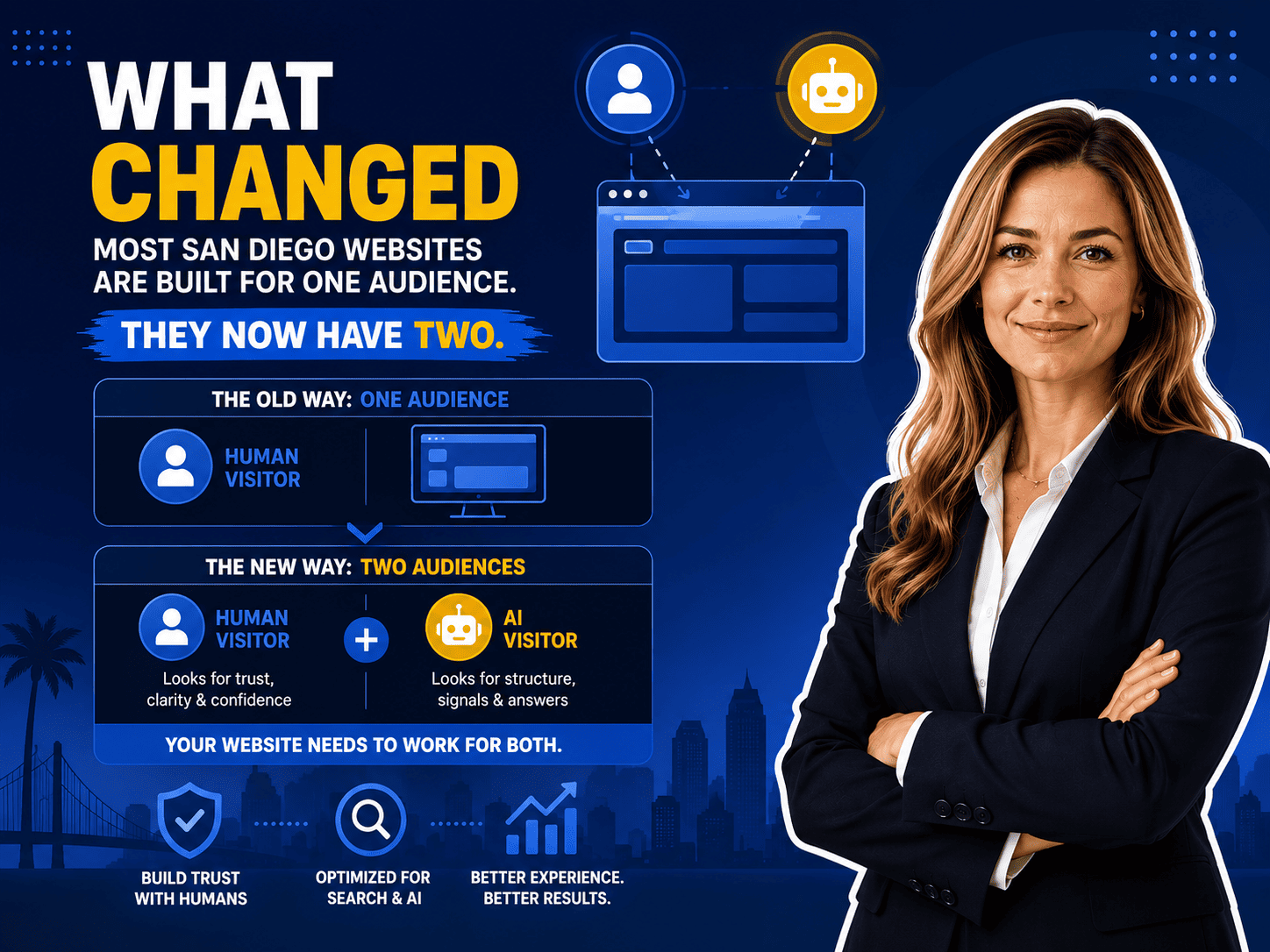
Most San Diego websites are built for one audience. They now have two.
For twenty years a business site had one job: look credible to a human who arrived from a Google result. The agencies that built their reputations here between 2000 and 2010 are still selling that job. The job moved.
Your website now has to satisfy a second reader - a retrieval system that scrapes, parses, and decides whether your business is specific enough, structured enough and trustworthy enough to name.
That reader does not care about your hero animation. It cares whether your services are stated in plain language a machine can extract. Whether your service area is unambiguous. Whether your pricing, process and credentials exist as text rather than as an image or a PDF. Whether your schema markup tells it what kind of business you are. Whether the page renders fast enough to be crawled cleanly.
And here is the part that makes this worth doing rather than despairing about. Fewer clicks are getting through, but the ones that do are better: multiple 2026 studies put AI-referred conversion rates at three to four times the average organic visitor. The businesses that win are the ones structured to be picked.
That is what we mean when we say a site should be built to be found. It is not a slogan. It is a build spec.
What "built to be found" means in practice
Six things we do differently from a template shop. None of them are visible in a mockup. All six decide whether the site earns anything.
Entity clarity
Your business, services, service area and credentials stated explicitly in crawlable text - not implied by a photograph or buried inside a hero video.
If a machine has to guess what you do and where you do it, it will guess wrong, or skip you entirely and name the competitor who spelled it out.
Written to be extractedStructured data that matches reality
ProfessionalService or the right vertical type, areaServed, hasOfferCatalog, FAQPage, BreadcrumbList, Organization with verified sameAs links. Schema hands a search engine a labelled version of your page instead of asking it to infer one.
It also has to match your Google Business Profile exactly. Mismatched name, address and phone data is the most common local SEO own-goal we find on audits.
NAP checked against GBPAnswer blocks
Every page that could plausibly answer a question answers it in the first forty to sixty words, directly, before any preamble.
Roughly 58% of the queries that trigger an AI Overview are question-format, and queries of eight words or more are about seven times more likely to trigger one. If your answer is in paragraph six, it does not get extracted.
Direct answer firstCore Web Vitals as a build constraint
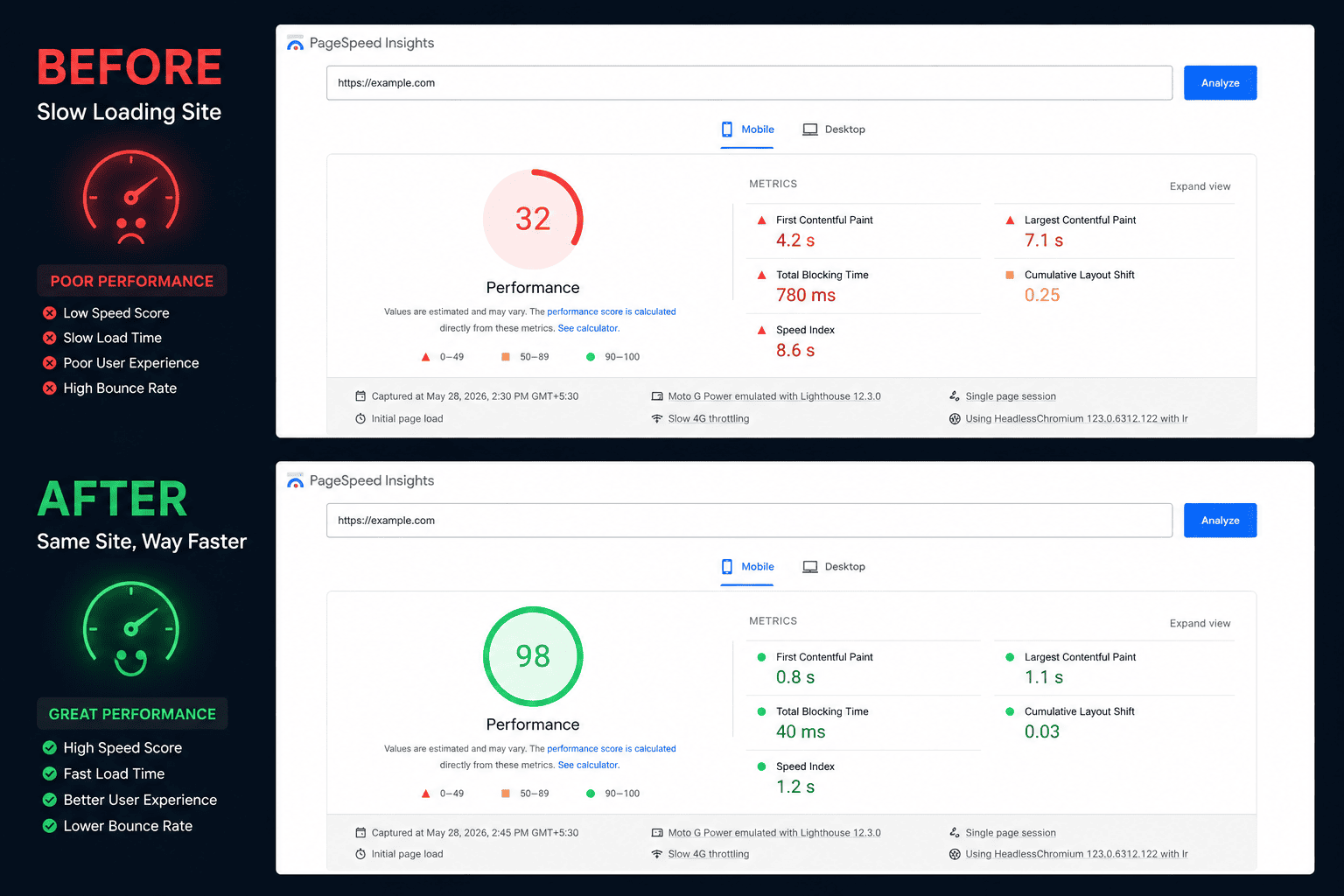
LCP, CLS and INP - the interaction metric that replaced FID in 2024 - are budgets we design against from the wireframe stage, not a cleanup task after launch.
It is far cheaper to not build a slow site than to fix one. Mobile is around 60% of web traffic, and a desktop score of 95 tells you nothing about a phone on cell data in Sorrento Valley traffic.
Tested on a real phoneA real information architecture
Service pages, industry pages, location pages and supporting content linked in a deliberate hierarchy, so authority flows to the pages that make money.
Not pooling on a blog nobody reads, and not scattered across forty near-identical suburb pages that Google has gotten very good at recognising as filler.
Structure before contentDepth on the pages that survive
Comparison content, pricing content and decision content hold up in AI search far better than generic how-to articles, because they need judgment and named entities a summariser cannot fully substitute for.
Informational queries run about 74% zero-click. Transactional queries run about 31%. We build toward the second number.
Built for buyers, not readersIf you have a storefront and a website in San Diego, you have exposure most states don't
Almost no local web design company will bring this up before you sign. It is the single most under-discussed fact in this market, and it is specific to California.
Here is the nuance almost every explanation gets wrong.
If you look only at federal filings, California appears quiet - four new federal website cases in all of 2025. That number is misleading. Ninth Circuit precedent limits federal ADA claims against online-only businesses, so the activity moved into California state court under the Unruh Civil Rights Act, which offers statutory damages and attorney's fees. That makes California one of the busiest accessibility jurisdictions in the country by actual filings, while looking almost inactive in the federal data everyone quotes.
Overlay widgets do not protect you. Plaintiffs' filings now cite them specifically as evidence that code-level barriers went unaddressed. If a vendor offers you a $49-a-month script as an accessibility solution, that vendor has not read the case law.
And the industries being targeted are San Diego's industries. E-commerce accounts for roughly 79% of 2026 filings; restaurants and food service are a clear second. San Diego County has about 100,000 accommodation and food service employees and a restaurant and brewery scene with real national profile. Med spas, dental practices, hotels and home services with online booking are all in the pattern.
A manual accessibility audit costs $2,500 to $10,000. Building to WCAG 2.1 AA from the start costs approximately nothing extra, because it is a set of decisions about semantic markup, contrast, focus states, form labels and keyboard navigation - decisions you make once at the beginning, or pay for twice, later.
One honest caveat, because precision matters here: the DOJ's April 2026 Interim Final Rule extended the ADA Title II deadline for public entities by a year, and HHS pushed the Section 504 deadline to May 2027. Both are real. Neither creates a safe harbor from private Title III litigation or from Unruh claims against a private California business. Anyone telling you the deadline moved so you can relax is describing a different rule than the one that applies to you.
Web design services for San Diego businesses
No tiers built to push you upward, no page-count games, no "premium" bucket for things that should be standard.
Custom website design
Designed from your business, not from a marketplace theme with your logo dropped in. Custom architecture, custom layouts, a component system your team can extend.
Every buildWebsite redesign & rebuilds
The most common project we take on. We audit first, keep the URLs and rankings you have already paid for, and rebuild the rest. Redirect mapping is the first deliverable, not an afterthought.
Rankings preservedWordPress design & development
Clean custom themes and block patterns, not a pile of thirty plugins. An editor your marketing team can use without calling us. Hardened, backed up, monitored.
No plugin sprawlShopify & ecommerce
Product architecture, merchandising, checkout friction, and the structured data that makes products eligible for rich results. Built accessible from the start, because ecommerce absorbs roughly 79% of accessibility litigation.
$1,500 one-timeWebflow builds
For teams that want visual editing control with clean output. We will tell you honestly when Webflow is right and when WordPress serves you better - it depends on who maintains it after launch, not on which one we prefer.
Platform-agnostic adviceLanding pages & conversion work
Single-purpose pages for paid campaigns, launches and specific service lines. Built to be tested, with measurement in place before launch rather than bolted on after.
Tracked from day oneMobile-first responsive design
We design at 375px first and scale up. Designing desktop-first and shrinking is how you end up with a tap target nobody can hit and a phone number that will not dial.
375px firstSpeed & Core Web Vitals
Image strategy, font loading, script discipline, caching and CDN configured properly rather than left at plugin defaults. LCP, CLS and INP tuned before launch, not after.
Budgeted, not auditedAccessibility, WCAG 2.1 AA
Semantic structure, keyboard navigation, focus management, contrast, form labelling, alt text standards, and a documented remediation record. Code-level, not an overlay.
Included, not an upsellHosting & care plans
Managed hosting, SSL, daily backups, updates, uptime and security monitoring, and a defined monthly allowance of content changes. The common failure mode is not a bad launch - it is a good site left alone for three years.
Quoted separatelySEO foundations, included
Technical SEO, on-page structure, schema, internal linking, Google Business Profile alignment and Search Console setup ship with every build. You should not have to buy a retainer to get a technically correct website.
Not a separate invoiceBilingual & cross-border sites
Correct hreflang, separate indexable URLs, and Spanish content written by a person rather than a translate plugin. San Diego-Tijuana is the busiest land border in the hemisphere and a lot of local customer bases reflect that.
Rarely offered locallySan Diego's actual economy, not a generic industry list
Most agency pages list "healthcare, legal, home services, ecommerce" - a list that would read identically in Tampa or Columbus. San Diego's economy is genuinely unusual, and building for it well means knowing what is here.
Defense, GovCon & the supplier base
Defense activity generated around $63.2 billion of Gross Regional Product in 2024 - roughly 23.7% of the region's total - supporting about 369,000 jobs. Beneath the primes sits a deep bench of machine shops, engineering firms and specialty manufacturers competing for contracts.
Life sciences, biotech & medical device
The third-largest biotech concentration among US metros, average wages near $172,000, and a corridor now extending downtown as RaDD brings 1.7 million square feet to the waterfront. Investor-facing and customer-facing paths that don't collide.
Healthcare, dental & med spa
Healthcare and social assistance is the county's largest civilian sector at roughly 209,000 people. Patients are choosing between three practices on a phone. Insurance, parking and whether you can be seen this week beat the copy about your philosophy of care.
Restaurants, breweries & hospitality
Accommodation and food services accounts for about 100,374 jobs here. Menus as real HTML, not a PDF someone scanned in 2019. And accessibility that holds, because food service is the second most-sued category in the country right now.
Contractors & home services
Roughly 90,000 construction workers in the region. Service-area pages that don't cannibalise each other, licence and bond display, and a quote form that actually gets filled out from a job site on one bar of signal.
Law firms & professional services
A dense downtown legal market where every competitor's site looks the same. Practice-area architecture, attorney bio structure and consultation funnels that signal seriousness without reading like a stock photo library.
Real estate & property management
Median home price crossed $1.07 million in April 2026. This is a high-consideration market and the site has to carry that weight - including IDX integration that doesn't quietly destroy your Core Web Vitals.
Cross-border, logistics & manufacturing
Otay Mesa is absorbing a nearshoring wave, with logistics roles projected to grow around 21%. Genuinely bilingual sites, correct hreflang, and Spanish written by a human. We have not found another San Diego web design company leading with this.
Nonprofits, education & membership
Donation flows, volunteer pipelines and event calendars - plus accessibility obligations that are frequently stricter than a private business's, particularly for anything touching public funding.
Not on this list? Ask anyway. What we would want to know first is whether people in your area actually search for what you do - and if they don't, we will tell you a website is not the thing you need. See all industries we serve.

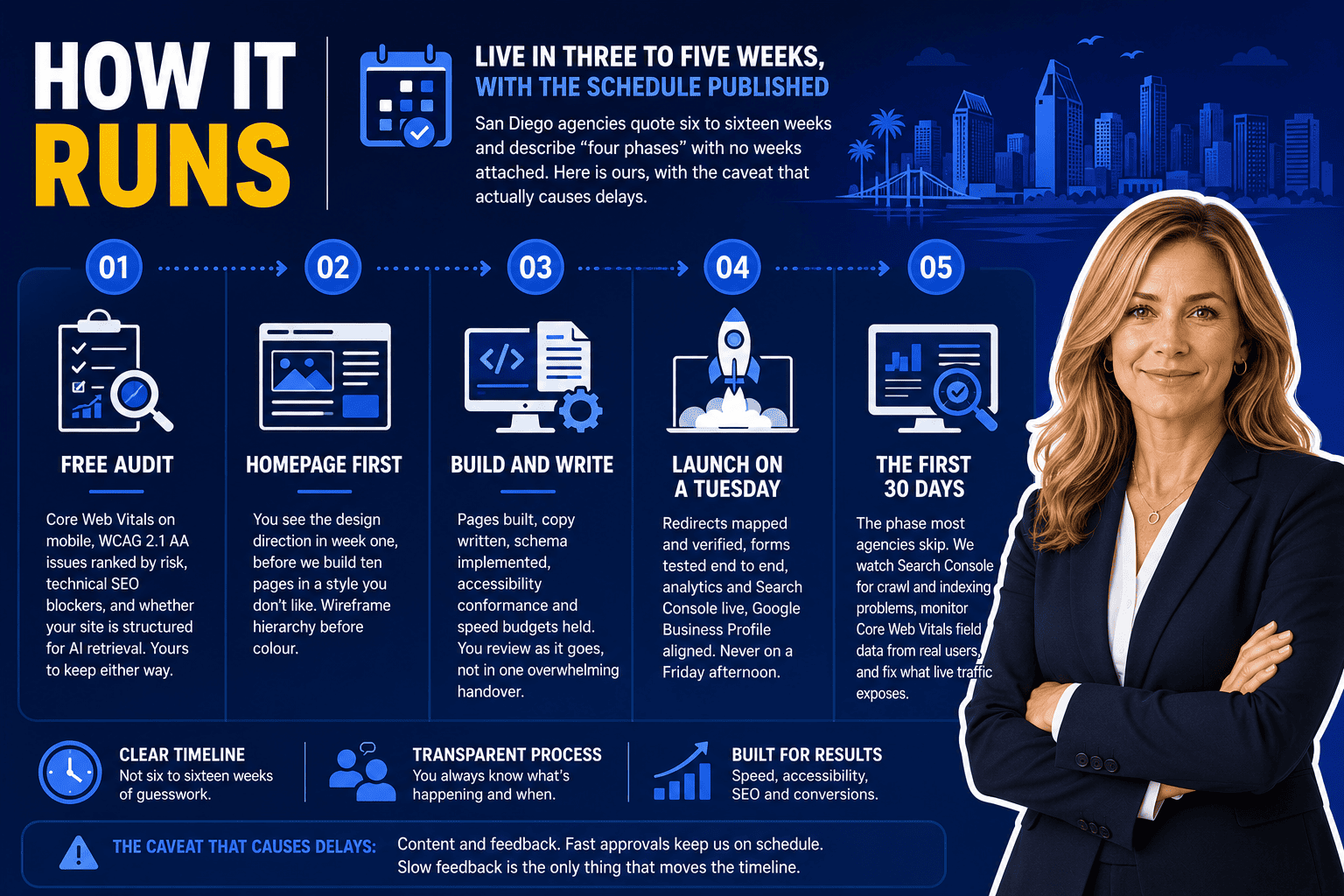
Live in three to five weeks, with the schedule published
San Diego agencies quote six to sixteen weeks and describe "four phases" with no weeks attached. Here is ours, with the caveat that actually causes delays.
Free audit
Core Web Vitals on mobile, WCAG 2.1 AA issues ranked by risk, technical SEO blockers, and whether your site is structured for AI retrieval. Yours to keep either way.
Homepage first
You see the design direction in week one, before we build ten pages in a style you don't like. Wireframe hierarchy before colour.
Build and write
Pages built, copy written, schema implemented, accessibility conformance and speed budgets held. You review as it goes, not in one overwhelming handover.
Launch on a Tuesday
Redirects mapped and verified, forms tested end to end, analytics and Search Console live, Google Business Profile aligned. Never on a Friday afternoon.
The first 30 days
The phase most agencies skip. We watch Search Console for crawl and indexing problems, monitor Core Web Vitals field data from real users, and fix what live traffic exposes.
The honest caveat: the biggest cause of delay in this industry is not build time, it is content - copy, photography and approvals. We write the copy, which removes the largest bottleneck. If you can turn feedback around in two business days, we hold the schedule. If you can't, tell us up front and we will build the timeline around reality instead of pretending.
What San Diego web design companies actually charge
Not our estimate. These are figures published by third-party directories and reported on agency profiles, with links so you can check them yourself.
The band reported for the city's best-known WordPress shop, founded in 2003, alongside a $10,000 project minimum and an hourly rate of $150 to $199. Another local firm sits at $10,000 to $25,000 per project. This is the going rate for a serious San Diego agency build.
Clutch's own San Diego web design category reports an average reviewed project cost under $10,000. Nationally, 61% of small business buyers spent less than $10,000 on their most recent website - down from 68% in 2023 as buyers ask for more custom work.
US agencies bill roughly $100 to $200 an hour for general work and up to $300 for senior development; experienced freelancers run $50 to $150, median near $85. The more useful fact: not one major San Diego competitor publishes a project price. One openly argues a website price is like asking "how much does a car cost."
Around five pages, copywriting and domain setup included, $1,500 if you need a store. Faster than the six to sixteen week norm because we write the copy instead of waiting on you for it. WCAG 2.1 AA and SEO foundations included. Hosting and ongoing support quoted separately.
Read this the right way. A $20,000 San Diego build is not a rip-off and our $1,000 is not a trick - they are different products. The expensive end buys you a larger team, a formal discovery process, and an account manager to call when a stakeholder changes their mind. We sit deliberately below it: custom design and written copy without the account management layer, which is the right trade for most small businesses and the wrong one for an enterprise with twelve stakeholders. What matters is knowing which one you are buying. Ask every San Diego firm on your shortlist to put their number in writing before the first call - and ask them directly whether accessibility and redirect mapping are included or billed separately.
A one-time build fee, published up front
Nearly every web design company in San Diego makes you get on a call before they will say a number. We would rather you know now whether we are in your range.
Lead-focused build, designed and written for you. Selling online instead? An ecommerce store is $1,500 one-time.
Get a free website auditHosting and ongoing support are quoted separately - we give you that number on the call rather than bury it in a footnote. For reference, the market runs $50 to $150 a month for basic care and $150 to $500 for full-service plans.
- Custom design built around your business - no purchased theme with your logo swapped in
- Copywriting for every page, written for you, in your voice
- Mobile-first responsive across phone, tablet and desktop
- Core Web Vitals budget - LCP, CLS and INP tuned before launch
- WCAG 2.1 AA accessibility conformance with a documented record
- Technical SEO foundations, schema markup and internal linking from day one
- Google Business Profile alignment so your NAP data matches everywhere
- Redirect mapping on every redesign, so you don't lose rankings you already paid for
- Forms built and tested end to end before launch, with spam protection
- Domain and DNS setup, including email deliverability records
- You own everything - domain, code, design files and content, in your name
That last one matters more than it sounds. Clutch's own San Diego buyer guidance lists "ownership confusion over design files or source code" as a red flag to watch for when hiring here. It is a real pattern in this market. We just don't do it.
We also don't build for everyone. If a template on a DIY builder genuinely fits your business, we will say so on the call rather than take your money. And if you need custom ERP integrations or a genuine web application, that is a different discipline - we will point you elsewhere. Want SEO running on the site afterwards? That is weekly and month to month: see SEO in San Diego or the full price list.
Waystar Studio vs. other San Diego web design companies
Anyone shopping for a San Diego business website is really choosing between five options. Here is an honest side-by-side - including the columns where somebody else is the better call.
| What you're comparing | UsWaystar Studio | San Diego web design agency | National / enterprise agency | Freelancer | DIY site builder |
|---|---|---|---|---|---|
| Build costOne-time, published up front | $1,000 $1,500 for ecommerce |
$6,000 – $25,000 | $15,000+ | $1,500 – $8,000 | No build cost |
| Price published before a callNo San Diego competitor does this | On this page | Quote after discovery | Contact sales | Varies | Public |
| WCAG 2.1 AA accessibilityUnruh Act exposure in California | Standard, code-level | Usually a paid add-on | Usually included | Rarely | Overlay widget at best |
| Structured for AI searchSchema, answer blocks, entity clarity | Built in | Rarely addressed | Sometimes | Rarely | Template-limited |
| CopywritingSomeone has to write it | Included, every page | Usually billed per page | Included | Sometimes extra | You write it |
| Bilingual / Spanish buildSan Diego-Tijuana customer base | Proper hreflang, human copy | Occasionally | Yes, at a price | Rarely | Translate plugin |
| Redirect mapping on redesignWhere rankings get lost | First deliverable | Usually, ask first | Included | Often missed | You handle it |
| Time to launch | 3 – 5 weeks | 6 – 12 weeks | 3 – 6 months | 4 – 8 weeks | A weekend |
| Hosting & ongoing support | Quoted separately | $150 – $500/mo | $500 – $2,000/mo | Rarely offered | Included in plan |
| You own the code & domainClutch flags this as a San Diego red flag | Always, in your name | Usually, check the contract | Usually | Varies | Platform-locked |
| Twenty-year local track recordWhere they beat us | Newer in this market | 1,000+ sites, 170+ reviews | Deep bench | Varies wildly | N/A |
| Custom apps & ERP integrationsBeyond a marketing site | Not what we do | Sometimes | Built for it | Depends | No |
About these numbers. The four right-hand columns describe common patterns across the San Diego web design market, drawn from published rate cards, third-party directory profiles and what clients tell us they paid before switching. They are not claims about any specific company - ask anyone you are considering to confirm theirs in writing. Three rows go against us on purpose: a DIY builder has no build cost and bundles hosting, a national agency is the right call for custom integrations or a genuine web application, and the established San Diego shops have a two-decade local track record and review volume we do not.
What clients actually say
A law firm, an auto shop and an industrial cleaning company. Real clients, real words. See the full breakdown on our Projects page.
I liked working with these guys, super fast work, and honestly impressed with how much they do for so less.
We do industrial cleaning, and we have started to get 10-20 leads a month extra from our website. And in our industry the search demand is really low and most of it goes to companies running PPC, so even one or two extra clients a month means $40-50K per month for at least a year.
Reviews are published as written, with only spelling and punctuation corrected. Results described are those clients' own - lead volume and contract values vary a great deal by industry and service area, and nothing here is a projection of what your business would see.
Where we build across San Diego County
Our office is at 1420 Kettner Blvd in Little Italy, a few blocks from the waterfront, the County Administration Center and the new Research and Development District. Most established San Diego web design firms sit eight to twelve miles north in Kearny Mesa, Sorrento Valley and Mission Hills. If you are downtown, we can meet in person this week.
Somewhere not listed? Ask anyway - the county is bigger than any list, and the work runs by phone, text and email regardless of where you are. Waystar Studio also has offices in Houston, TX and Nashua, NH, which in practice means a San Diego client gets replies starting at 7am Pacific. Get a free audit of your current site.
San Diego web design, answered
We charge $1,000 one-time for a business website of around five pages, or $1,500 for an ecommerce store, with copywriting and domain setup included. For context: Clutch reports the average reviewed web design project in San Diego comes in under $10,000, and established local agencies typically land between $6,000 and $25,000 with hourly rates of $150 to $199. Freelancers run $1,500 to $8,000. Anything under about $500 is almost always a template with your logo on it.
If you have a physical location and a website, assume yes. California is one of the most active accessibility-litigation jurisdictions in the country, with most claims filed in state court under the Unruh Civil Rights Act rather than under federal ADA Title III. California filings rose from 144 in Q1 2025 to 194 in Q1 2026. Reported California settlements cluster around $65,000, and settlement plus defense costs nationally range from $60,000 to over $200,000. We build to WCAG 2.1 AA as standard, at no extra cost.
No, and the data is unambiguous. In July 2026, 113 of 401 accessibility defendants were sued while running a third-party widget. In January 2026, 26% of suits targeted sites that already had one installed. Plaintiffs' filings increasingly cite widgets as evidence that underlying code barriers were never fixed. Only code-level remediation reduces risk.
Usually one of four things: AI Overviews are absorbing clicks on your queries, your technical foundations are weak, a competitor out-invested you, or a redesign broke your redirects. The landscape genuinely shifted - about two-thirds of Google searches now end without a click, and organic CTR drops roughly 58 to 61% when an AI Overview appears. Ranking the same and getting fewer clicks is now a normal pattern, and the fix is different from the old fix. Our free audit identifies which of the four is happening to you.
Be specific, be structured, and be extractable. That means clear entity information about who you are and where you operate, accurate schema markup, direct answers stated in the first forty to sixty words of a section, depth on comparison and decision topics rather than generic how-tos, and clean, fast, crawlable pages. It is worth the effort: brands cited in AI Overviews earn roughly 35% more organic clicks than uncited competitors, and AI-referred visitors convert several times better than average organic traffic.
Three to five weeks for a typical San Diego small business site. The San Diego market norm is six to twelve weeks, and national agencies quote twelve to sixteen. Most of that gap is not development time - it is waiting on content, photos and approvals. We write the copy, which removes the biggest bottleneck. If you can turn feedback around in two business days, we hold the schedule.
Yes - domain, code, design files and content in your name from day one, stated in the contract. If you leave, you take everything and we help with the handoff. This matters more than it sounds: Clutch's own San Diego buyer guidance lists "ownership confusion over design files or source code" as a red flag to watch for when hiring here. Ask every agency on your shortlist directly, and get the answer in writing.
Hire a freelancer if you need a straightforward site, have a clear scope, and can manage the project yourself. Hire an agency if your site is a primary revenue channel, needs multiple specialties - design, development, SEO, accessibility, copy - or needs support that will still exist in two years. A freelancer costs $1,500 to $8,000; a San Diego agency typically starts around $6,000. The right answer depends on what the website has to do, not on which is objectively better.
Sometimes. If you are brand new, mostly referral-driven, or testing an idea, a DIY builder is a legitimate and sensible choice, and we will tell you so on the call. The limits appear when you need custom functionality, competitive SEO structure, real performance work, or design that differentiates you. Most businesses that start on a builder commission a professional rebuild within about two years, which means paying twice.
Yes, and it is a standard part of every redesign. We audit existing rankings and traffic first, preserve URLs where it makes sense, build a complete redirect map before launch, verify it after, and monitor Search Console through the first thirty days. Expect a brief wobble in the first two weeks even when it is done right - that is Google recrawling, and it settles. Lost rankings after a redesign are almost always a redirect failure, and redirect failures are preventable.
Usually WordPress, Shopify or Webflow, chosen based on who maintains the site after launch and what it has to do - not on which one we prefer. WordPress for content-heavy sites with complex structure. Shopify for retail. Webflow when a marketing team wants visual editing control with clean output. We will explain the trade-off before you commit, and we will tell you if the platform you already have is fine.
Yes. San Diego-Tijuana is the busiest land border crossing in the hemisphere, and a lot of San Diego businesses have a real Spanish-speaking customer base - particularly in Chula Vista, National City, San Ysidro, Otay Mesa and City Heights. Done properly that means correct hreflang implementation, separate indexable URLs, and Spanish content written by a person, not a translate plugin, which produces content search engines discount and customers notice.
Managed hosting, SSL, daily backups, core and plugin updates, security and uptime monitoring, performance checks, and a monthly allowance of content changes. You need one if you do not have someone in-house doing it. Market rates run $50 to $150 a month for basic care and $150 to $500 for full-service plans. The alternative is ad-hoc hourly work at $75 to $150 an hour, which is almost always more expensive and much slower.
We can - our office is at 1420 Kettner Blvd in Little Italy, walkable from downtown, the County Administration Center and the RaDD waterfront district. That said, everything runs fine by phone, text and email: the audit, the design review and the launch. Most established San Diego agencies are eight to twelve miles north in Kearny Mesa and Sorrento Valley, so if you are downtown and want to shake a hand, we are the short drive.
The whole county. San Diego proper - Downtown, La Jolla, North Park, Point Loma, Pacific Beach, Sorrento Valley, Kearny Mesa, Mission Valley, Carmel Valley, Rancho Bernardo, Barrio Logan and Otay Mesa - plus Chula Vista, National City, Coronado, La Mesa, El Cajon, Santee, Poway, Escondido, San Marcos, Vista, Oceanside, Carlsbad, Encinitas, Solana Beach and Del Mar.
Yes, but they are priced separately. The website is a one-time build fee; SEO runs weekly, month to month. Technical SEO foundations, schema and structure are included in every build - you should not have to buy a retainer to get a technically correct website. A lot of San Diego businesses start with the site and add campaign work once it is live, which is usually the right order.
Let's see what your site is actually doing
A free audit: Core Web Vitals including INP on mobile, WCAG 2.1 AA issues ranked by litigation risk, technical SEO blockers, whether you are structured for AI retrieval, and the three things we would fix first. Takes us about twenty minutes and it is yours whether or not you hire us. If the fix is small enough to do yourself, we will say that.
Waystar Studio · 1420 Kettner Blvd, San Diego, CA 92101 · hello@waystar.studio